
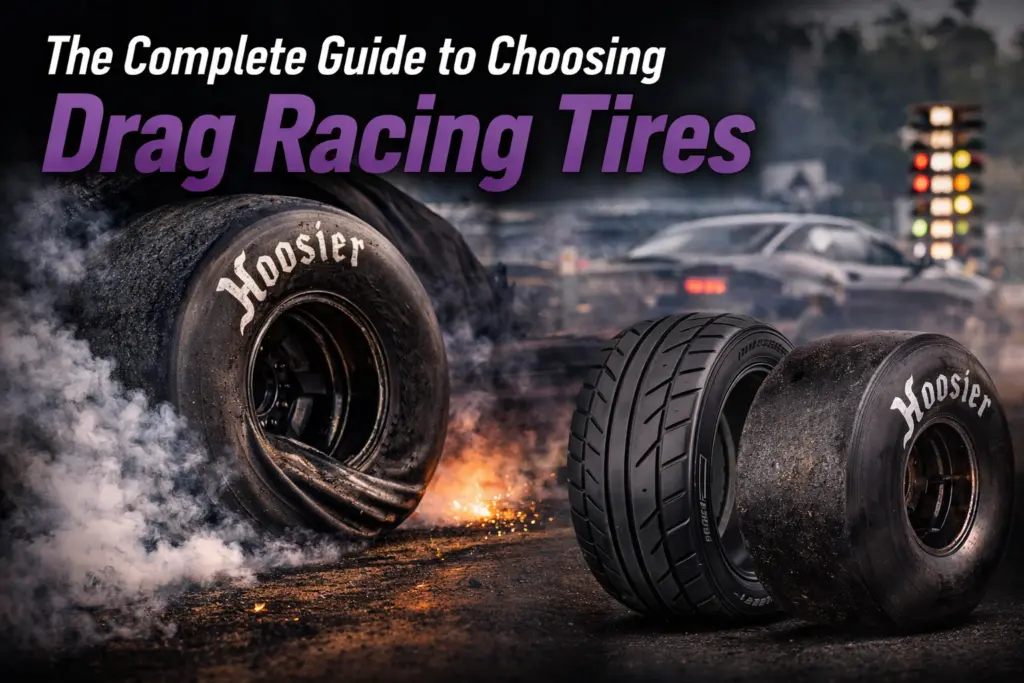
Choosing the right drag racing tire can be the difference between a personal best and a broken part. Whether you’re a first-timer at the strip or a seasoned bracket racer, this guide covers everything you need to know about selecting, running, and maintaining your Hoosier drag tires.
Slicks vs. Radials vs. DOT Drag Tires
Hoosier makes three main categories of drag tire, and understanding the differences is the first step to making the right choice.
Drag Slicks (Competition Only)
Purpose-built bias-ply tires designed for maximum traction at the strip. Slicks are lighter than radials and offer the most consistent hookup for vehicles that can manage wheel spin. They’re not street legal — these are for the track only.
- Best for: Dedicated race cars, high-horsepower builds, bracket racing
- Pros: Lightest weight, maximum traction, multiple compound options
- Cons: Not street legal, require trailer to the track
DOT Drag Radials
These are steel-belted radial tires that meet DOT standards for road use but feature softer racing compounds and low-profile tread patterns that behave more like a slick at the strip. They’re the most popular choice for street/strip cars.
Important: While DOT-approved, Hoosier lists these as “designed and manufactured for racing purposes only.” They’re legal on the road, but their primary purpose is performance at the drag strip.
- Best for: Street/strip cars, grudge racing, cars that drive to the track
- Pros: Street legal, stiffer sidewalls improve top-end stability, good ET improvements
- Cons: Heavier than slicks, less traction than a true slick
Drag Front Tires
Don’t overlook the front end. Hoosier’s drag front tires are designed with lightweight construction and minimal rolling resistance, giving you precise control and stability during high-speed runs. Reducing rotating mass up front helps reduce ETs and improves overall vehicle balance.
Choosing the Right Compound
Compound selection is critical — get it wrong and you’ll either smoke the tires or wear them out in a single session. The rule is simple:
- Lighter vehicles → softer compound (more grip, controlled spin)
- Heavier vehicles → harder compound (handles the load, longer life)
Your transmission type also matters. Automatic transmissions tend to load the tyres harder on launch, so they benefit from a compound that can handle dead-hook launches. Manual transmissions produce more controlled spin, so a slightly softer compound can work well.
Tyre Pressure — Run More Than You Think
One of the most common mistakes in drag racing is running too little air pressure. Counter-intuitively, more pressure generally means better performance in drag tires.
Recommended starting points:
- Bias-ply slicks: approximately 12 psi
- DOT drag radials: 18–22 psi
Insufficient pressure causes wheel hop and tyre cupping — both of which kill your ET and can damage your drivetrain. Start at the recommended pressure and adjust from there based on your 60-foot times.
Breaking In New Drag Tires
New drag tires need a break-in period before they deliver peak performance. During the first 3–15 passes (depending on compound), the tyre surface is establishing its grip pattern. During this period:
- Follow the manufacturer’s directional mounting instructions
- Make progressively harder launches rather than going full power immediately
- Allow the tyres to reach operating temperature gradually
Maintenance and Inspection
Drag tires take tremendous abuse, so regular inspection is essential:
- Inspect every 10–20 passes (more frequently for high-horsepower cars)
- Check tread depth at multiple points — uneven wear indicates pressure issues
- Rotate side-to-side regularly to prevent tread balling and extend tyre life
- Use wheel screws (6–8 per wheel) on soft compounds to prevent tyre slippage on the rim during launch
- Mark the tyre and rim with chalk to detect any rotation between passes
Storage Tips
Drag tires are an investment. Protect them between race days:
- Remove them from the car or jack the car up to take weight off the tyres
- Drop air pressure to approximately 5 psi for storage
- Keep them out of direct sunlight, away from welders, electric motors, and UV light
- Store in a cool, dark location
Ready to Choose Your Drag Tires?
Hoosier has been building championship drag tires since 1957. From front runners and bias-ply slicks to DOT drag radials, there’s a Hoosier tyre engineered for your exact application.
Browse the full Hoosier drag tyre range or chat with us on WhatsApp — we’ll help you find the right rubber for your setup.